In the early 2000s, the “China shock” meant cheap toys, textiles and steel flooding into the Western markets. Twenty years later, the second “China shock” is bigger, faster and aimed at much higher up the value chain. The current challenges differ from those experienced during the first “China shock” in the early 2000s and the pressure is now breaking across some of the Europe’s prized industries. The playbook is very much familiar, and if you haven’t been living under a rock, the outline of a third wave is already visible in AI. With respect to AI, Europe is more of an implied bystander at the moment.
I found three recent sector-specific analyses that offers useful reference points. I understand that this is not the whole landscape, but it is good enough to sketch the shape of the challenge. The three sectors together, provide a representative cross-section of the challenge: manufacturing captures the wider shift in trade, production and value chains; wind energy illustrates the strategic dependence created by green transition; and automotive shows how Chinese competition is reaching a flagship European industry with deep employment, investment and regional consequences. I reckon that other sectors - such as machinery, batteries, electronics, and solar are also under similar pressure.
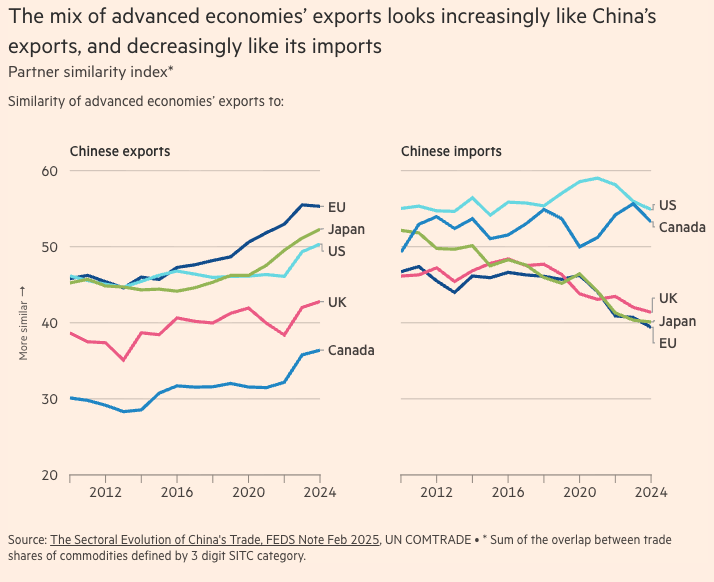
- Manufacturing: Manufacturing continues to be the central to the Europe’s economy. The share of manufacturing fell down to 14.3% from 17.4% of GDP from year 2000 to 2024. However, aim to reverse the trend and now targeting to rebound toward 20% by 2035. Trade became more and more imbalanced. In 2024, Europe exported goods worth of €213.3 billion to China whereas imports totaled €517.8 billion. China currently is Europe’s largest importer from outside of EU, making up 21.3% of total imports, but only the third largest exporter to Europe, providing only 8.3% of Europe’s exports. During 2014-24, EU imports from China increased 102% whereas exports increased only 47%, and in 2025 exports even went down whereas imports continued increasing. European Central Bank’s modeling shows that Chinese imports affect Europe in two opposite ways. Cheaper Chinese components and materials can lower costs and support European production, while cheaper finished goods can take sales away from European manufacturers. The first effect could raise EU industrial production by 0.6pp (percentage points), while the second could reduce it by 1pp. In the short term, cheaper imports may benefit consumers and some businesses; over time, however, they could weaken Europe’s industrial base and increase its dependence on China.
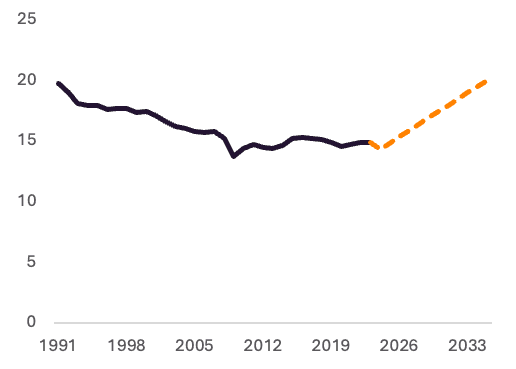
Re-industrialisation on steroids, manufacturing in GDP of EU (1991-2035) | Source: Erik van der Marel, ECIPE
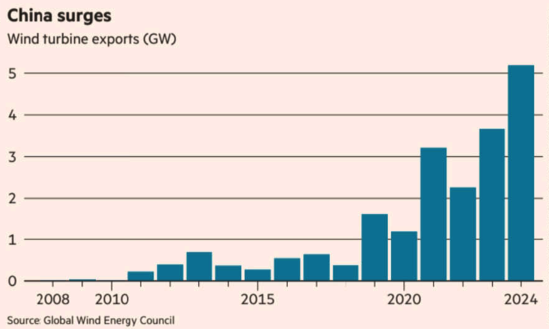
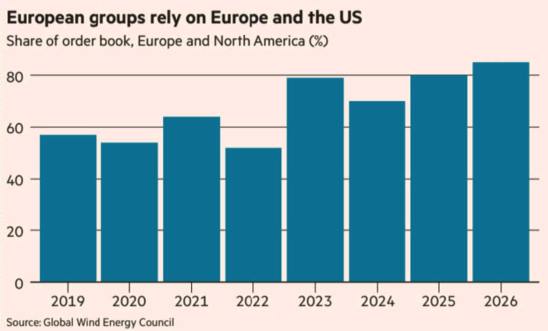
- Energy (Wind): Wind tells a similar story, just with harder numbers. Chinese turbine exports were basically nothing in 2008. By 2024, they’d surged past 5GW. At home, four Chinese suppliers; Goldwind, Envision, Windey and Ming Yang - control 99.96% of the domestic market. Together they installed 120GW of turbines last year alone. That’s more than 70% of everything installed globally that year. Europe’s own manufacturers supply about 94.5% of their home market. But the total they installed came in just under 20GW, a fraction of China’s output. For the first time last year, the top five turbine makers globally by annual new capacity were all Chinese. Goldwind alone put in roughly double what Vestas, Europe’s biggest player, managed worldwide: 30GW vs 14.5GW, driven mostly by its dominance at home. Rystad Energy reckons Chinese turbines run 20–40% cheaper in the export markets where the two sides go head-to-head. Wood Mackenzie expects Chinese firms to grab more than a quarter of all onshore capacity installed outside China over the next decade. Unsurprisingly, Europe’s response is starting to look defensive. Vestas, Siemens Gamesa, Nordex and Enercon are now openly talking about merging into “European champions.” They’re clawing back from heavy 2022 losses along the way - Vestas shares are up roughly 40% over the past year, Nordex’s about 90%. It’s the same logic that built Airbus to take on Boeing, just aimed this time at a much bigger and far more subsidised rival.
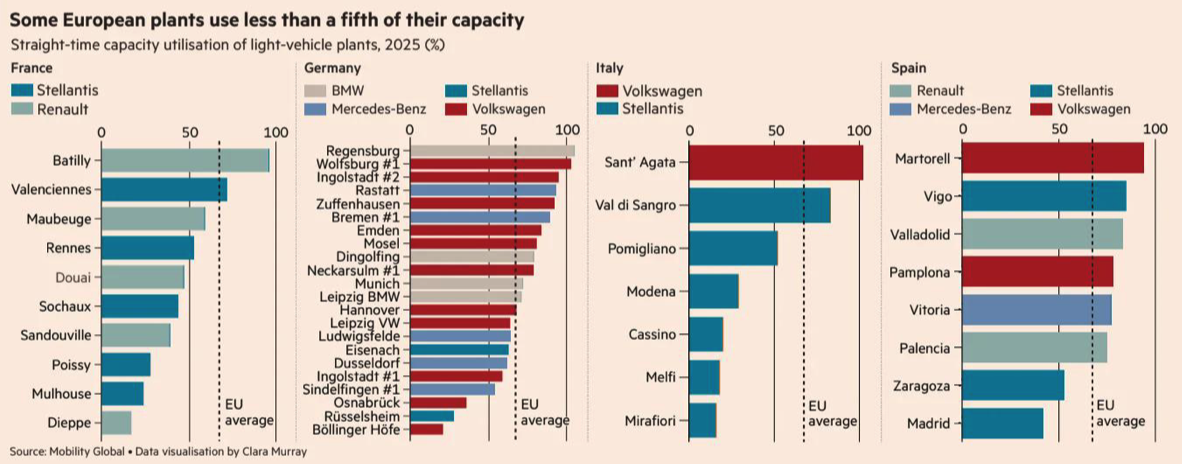
- Automotive: Cars are Europe’s flagship industry, about 7% of EU GDP and nearly 14 million jobs , which is exactly why this one stings the most. Car sales are still roughly 3 million below pre-pandemic levels, Chinese entrants keep gaining ground, and utilisation across the sector has slipped under 60%, leaving the capacity to build some 2.5 million vehicles sitting idle, according to AlixPartners. Stellantis’s Cassino plant in Italy shows what that looks like on the ground: its 2,200 workers are now called in for only a few days a month, and the plant built just 6,700 cars in the first half of 2026 against an annual capacity of 300,000. Carmakers are responding the only way they know how, by teaming up with the very rivals squeezing them. Stellantis has brought in Leapmotor and Dongfeng at its Spanish and French plants, Nissan is working with Chery in the UK, Volkswagen is in talks with Xpeng, and Ford has struck a deal with Geely in Spain. “The goal is to get to the lowest cost,” is how Ford’s European boss put it when announcing the tie-up. Meanwhile China’s own car exports are set to jump 41% this year to more than 10 million vehicles, piling on even more pressure just as Brussels tries to respond. Its proposed Industrial Accelerator Act would require 70% of a car’s components to be locally made (as early as mid-2027) for manufacturers to qualify for subsidies or public contracts, with local battery rules expected to follow.
The first China shock hollowed out factory towns. The second is testing whether Europe’s most advanced industries can survive contact with a much bigger, much cheaper competitor.
Sources:
- Financial Times, “European wind turbine makers examine benefits of joining forces,” 29 July 2026
- Financial Times, “European carmakers forced into tie-ups with Chinese rivals to keep plants running,” 8 August 2026
- European Central Bank, “The impact of China’s industrial rise on the euro area,” Economic Bulletin, Issue 3, 2026 (Amicucci, Gnocato, Gunnella, Lindemann, Merendino, Montes-Galdón)
- Erik van der Marel, “Europe Cannot Reindustrialise Its Way to the Future,” ECIPE, March 2026, using World Bank WDI data
- Eurostat, EU-China goods trade data, 2024–2025