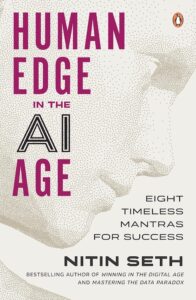
While many leading AI books tackle critical macro questions, geopolitical power shifts, AI containment risks, and existential threats, “Human Edge in the AI Age” by Nitin Seth takes a different angle entirely. One that feels more personal, and more immediately actionable: your own evolution.
A different kind of AI book
The conversation around artificial intelligence has never been louder. Researchers, economists, and technologists debate AGI timelines, labour displacement, and the geopolitical race between nations and corporations. These are important questions. But they can also feel distant — systemic challenges that seem to require systemic solutions.
What Seth offers in Human Edge in the AI Age is something more intimate. Rather than asking what AI will do to the world, he asks what you will do with yourself. It is a book about cultivating the qualities that make human beings not just useful alongside AI, but genuinely irreplaceable.
If you haven’t read it yet, move it to the top of your list.
The POSSIBLE framework
At the heart of the book lies the POSSIBLE framework — eight timeless mantras that Seth believes define what makes us irreplaceable in an AI-driven world. The acronym is more than a mnemonic. Each letter represents a deep capability that algorithms, however powerful, cannot fully replicate.
Problem-Solving Openness Spirituality Sportsmanship Impact Balance Leadership Entrepreneurship
What makes this framework distinctive is where it draws its inspiration. Seth blends sharp McKinsey strategy — he is a former McKinsey partner — with the wisdom of Indian philosophy, including the Yoga Sutras and the Bhagavad Gita. It is an unusual combination, but it works. The result is a framework that feels both rigorous and deeply human.
Practical, not perspective
One concern with frameworks is that they can feel abstract. Intellectually satisfying, but difficult to act on. Seth sidesteps this neatly. Each chapter closes with concrete steps you can apply immediately. It felt less like reading a strategy playbook and more like a conversation with someone who has thought deeply about these questions and genuinely wants you to find your own answers.
Unlike most business books that leave you inspired but a little adrift, this one lands differently.
For tech leaders and product professionals accustomed to frameworks that are long on vision but short on execution, this is a meaningful distinction.
The Era of Entrepreneurs
Perhaps the most striking idea in the book is Seth’s reframing of AI’s impact on jobs. Where many commentators see displacement, Seth sees possibility. He argues that we may be entering what he calls an “Era of Entrepreneurs” — a moment in history where those who cultivate creativity, empathy, resilience, and purpose will find themselves more relevant, not less.
This is not naive optimism. It is grounded in a clear-eyed understanding of what AI is genuinely good at — pattern recognition, optimisation, prediction — and what it cannot access: awareness, consciousness, the deeper sense of being that animates human decision-making and human connection.
Seth makes a compelling case that empathy and resilience are not soft skills in the pejorative sense. They are distinctly human superpowers. The ability to feel what another person is experiencing, and the capacity to grow stronger through difficulty rather than merely recovering from it — these are capabilities that no model, however large, can replicate from the inside.
Indian Philosophy meets modern strategy
The integration of Indian philosophical tradition is one of the book’s most distinctive and rewarding qualities. Drawing on the Yoga Sutras and the Bhagavad Gita, Seth offers a contemplative counterweight to the relentless productivity discourse that dominates most leadership writing. In a world where we are becoming increasingly algorithm-driven and reward-focused — shaping identity based on external validation and measurable outputs — this philosophical grounding feels not just interesting, but necessary. It invites a different question: not just what are we optimising for, but what are we actually building in ourselves?
Pair it with other reading
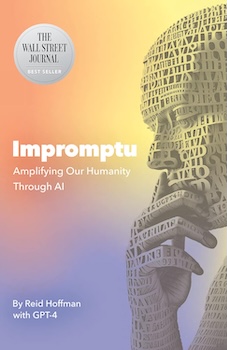
For those exploring human-AI collaboration more broadly, pairing Human Edge with Impromptu by Reid Hoffman makes for a rich reading journey. Hoffman explores the creative and leadership potential of working alongside AI, while Seth adds a philosophical grounding and structured inner framework that is genuinely rare in this space. Together, they offer both the external landscape and the internal one.
Who should read this?
This book is essential reading for tech leaders, product professionals, and anyone building their edge in an AI-driven world. But it is equally relevant for those who are not in technology — for anyone asking how to remain purposeful, connected, and whole in a world that is changing faster than most of us can process.
Seth does not pretend that navigating this era is simple. But he offers something valuable: a structured way to think about what matters, and a set of practices for building it deliberately.
In a world moving this fast, it is worth pausing to ask what we are actually building in ourselves.