Are you the CEO of your product, or just its project manager?
For years, I thought I was the former. I owned the roadmap. I ran the standups. I prioritized the backlog. I shepherded features from conception to launch.
Then came the launch that changed everything.
We shipped on time. Every checkbox was green. The engineering team high-fived. Marketing sent the announcement.
Two weeks later, usage was dead. Revenue impact: zero. Customer feedback: confused silence.
In the post-mortem, our VP asked one question that shattered my illusion:
“Who decided this would actually solve the customer’s problem?”
The room went silent.
We’d built what was asked. We’d delivered on time. But no single person had truly owned whether it would work.
I wasn’t a product owner. I was a proxy—managing outputs while real ownership lived in a vacuum between stakeholders.
That experience taught me something fundamental: product ownership is not defined by what you’re responsible for on paper. It’s defined by what you can’t walk away from when things get messy—when tradeoffs hurt, when outcomes disappoint, and when reality refuses to follow the roadmap.
Why Product Management Exists: Closing the Ownership Gap
What I experienced wasn’t unique. It’s the same pattern that led to product management existing in the first place.
As products grew more complex, teams specialized. Engineers focused on feasibility. Designers focused on usability. Business leaders focused on profitability. Marketing focused on positioning and demand.
Each function owned a piece. No one owned the whole.
Coordination solved some problems—things shipped more predictably—but it didn’t solve the deeper one: Who is accountable for whether this product actually works for customers and the business?
Product management exists to close that gap.
The core idea behind product management is simple:
You can outsource delivery to consultants or vendors. You cannot outsource ownership of what the product is, why it exists, and whether it’s working.
So product management exists to unify customer insight, business viability, technical constraints, and delivery priorities into a single point of accountability for outcomes, not just output.
Not the person who “owns the backlog.” The person who cannot look away from the question: “Is this the right product, and is it actually working for our users and our business?”
This is the essence of product ownership.
Outcome Ownership vs Output Ownership
A lot of confusion around product ownership comes from mixing up outcome and output.
Owning output sounds like: “We launched the feature.” “We hit the sprint goal.” “We delivered everything on the roadmap.”
Owning outcomes sounds like: “We reduced onboarding drop-off by 23%.” “We increased expansion revenue by 15%.” “We cut support ticket volume on this flow in half.”
Consider two ways of describing the same authentication problem:
The Proxy: “As a user, I want to log in so I can use the system.”
The Owner: “Authentication failures increased 73% in six months, reducing daily active users by 52% and costing us roughly $1M per day. If we remove the password field and use one-time codes, we estimate we could recover about $800K in daily revenue.”
The proxy manages backlogs. The owner manages business impact. One describes a task. The other tells a story with stakes, evidence, and a measurable outcome.
A useful way to think about responsibilities: Product managers own value and viability. Designers own usability. Engineers own feasibility.
But someone—explicitly—must own the uncomfortable question: “Is this product succeeding in the real world?”
When that question is nobody’s job, teams fall back to a safer one: “Did we build what we planned?”
That’s how organizations end up with roadmaps delivered on time, backlogs beautifully groomed, governance satisfied—and products that quietly fail.
Real product ownership means owning outcomes, not just output.
When Splitting the Role Recreated the Problem
As organizations scaled, the demands on product managers became overwhelming. The common response: split the role into Product Manager (strategy) and Product Owner (execution).
On paper, this looked reasonable. In practice, it often recreated the original ownership vacuum.
Strategy lives in one head. Execution lives in another.
When outcomes miss, who is actually accountable? The PM can point to execution gaps. The PO can point to strategic ambiguity. The ownership gap reappears.
Teams shipped faster. Ceremonies improved. Dashboards looked healthier. But the critical line between why something should exist and what actually ships began to blur.
Ownership became distributed just enough that no single person felt unable to walk away when outcomes disappointed.
The very problem product management was created to solve had quietly returned.
Product Ownership at Airbnb: Labels vs Real Accountability
Some companies are attacking this problem from the opposite direction—not by adding roles, but by collapsing them.
Airbnb under Brian Chesky is a striking example.
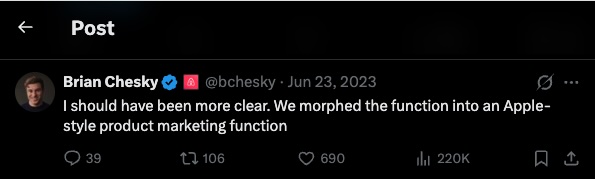
In 2023, headlines screamed that Airbnb had “killed product management.” That makes for great clicks, but it’s not what actually happened. Chesky, a designer by background, didn’t eliminate product thinking. He remixed the roles around it.
Airbnb combined product management with product marketing into what Chesky calls an “Apple-style product marketing function.” As he explained at Figma’s Config conference: “You can’t develop products unless you know how to talk about the products.”
The move targeted three problems:
- Elevating design from service to partner: Designers weren’t just there to “make it pretty” after decisions were made. They became equal partners in defining what the product should be.
- Reducing layers and coordination tax: By collapsing adjacent roles, Airbnb removed the handoffs and misalignments between “the person who defines the product” and “the person who positions it.”
- Clarifying outcome ownership: One person, or one clearly defined role, owns both what ships and how it’s understood in the market. Fewer proxies. Clearer accountability.
The result: smaller teams, tighter feedback loops, and less ambiguity about who owns outcomes.
So no, Airbnb didn’t “kill PMs.” It killed a particular flavor of proxy product management—where decisions and accountability are spread across so many people that no single person truly owns the bet.
Ownership did not disappear. If anything, it became sharper: Someone still made the hard calls. Someone still owned each bet. Someone was still answerable when things didn’t work.
AI, Builders, and the Future of Product Ownership
AI is now accelerating the compression of roles and responsibilities in product development.
Leaders like Gokul Rajaram have argued that as AI takes over more execution—writing code, drafting designs, automating tests—many traditional role boundaries will blur or collapse. In a recent post, Rajaram made a bold prediction: “The CPO role will vanish in five years.”
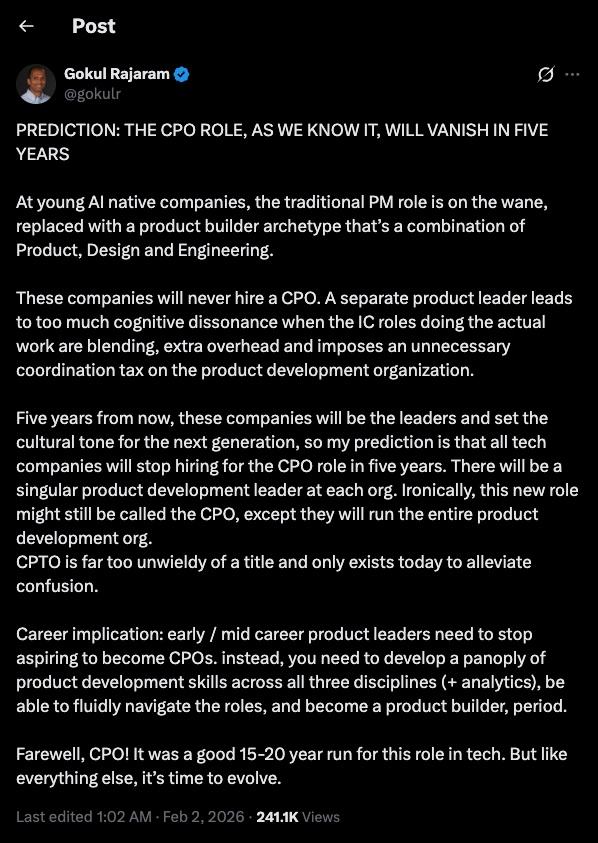
His reasoning centers on young AI-native companies where the traditional PM role is being replaced by a “product builder” archetype—a combination of product, design, and engineering skills in a single person.
Why this compression? Rajaram argues that maintaining separate product leaders creates “cognitive dissonance” when AI enables individual contributors to fluidly blend these roles. A dedicated CPO becomes “extra overhead” that “imposes an unnecessary coordination tax on the product development organization.”
Historically, org charts and titles existed to manage coordination across specialized roles. Different people did different parts of the work, so organizations created handoffs, layers, committees, and job families.
AI compresses a lot of that. A smaller number of “builders” can now explore solutions, build working versions, test with users, and iterate quickly.
Humans increasingly act as orchestrators, not just executors.
When that happens: Titles tend to compress. Ownership tends to concentrate.
The question “Who writes the user story?” matters less. The question “Who is truly accountable if this fails?” matters more.
Not everyone agrees with Rajaram’s timeline. Many product leaders argue that as shipping gets cheaper and faster, strategic oversight matters more, not less. Someone still has to own portfolio-level tradeoffs and cross-product bets.
But whether you agree with his five-year prediction or not, the underlying shift is hard to ignore: AI is making individual builders more powerful, and it is raising the bar on what ownership actually looks like.
Gokul’s core point is not that product, design, or engineering disappear. It’s that in an AI-accelerated world, the people who matter most are those who can own a problem end to end—from insight to iteration to impact—regardless of what their old title was. That is product ownership in its purest form.
What Product Ownership Really Means
That launch failure didn’t happen because people lacked talent, effort, or process. It happened because no one owned the outcome end to end.
Every role we’ve layered on since—product managers, product owners, “builders,” empowered teams, product leaders—is, at its core, an attempt to answer one recurring question: Who owns this?
Not “Who attends which ceremony?” or “Who updates the roadmap?” or “Who manages the backlog?”
But: “Who owns the outcome?”
This question scales across every level of an organization:
- At the feature or team level: Who owns whether this problem gets solved?
- At the product level: Who owns whether this product succeeds?
- At the portfolio or company level: Who owns whether our overall product bets create durable advantage?
Even as AI compresses roles at the bottom, these ownership questions don’t vanish. When revenue misses, churn spikes, or a big bet fails, someone still has to decide: Do we double down, pivot, or kill this? Which markets do we commit to, and which do we walk away from? What tradeoffs are we willing to accept?
You can call that person a CPO, Head of Product, GM, or something else entirely. The title is negotiable. The ownership is not.
At every level, product ownership looks like the same thing:
“I cannot walk away from the outcome, and I am empowered to change course when reality disagrees with the plan.”
Roles will keep changing. Frameworks will come and go. AI will reshape how products are built.
But as long as products exist, one thing will remain non-negotiable: Someone has to own the outcome.
And if you’re reading this, there’s a good chance that person is supposed to be you.